
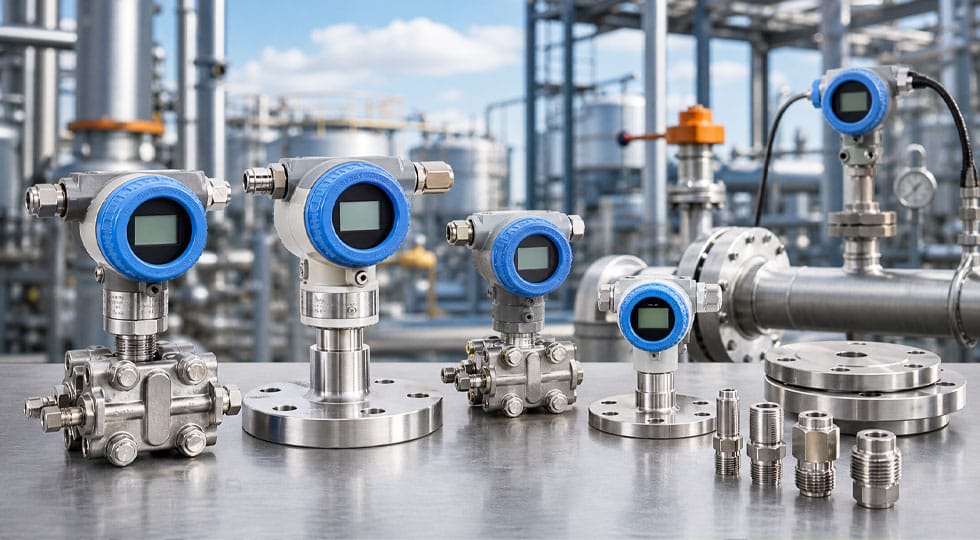
Pressure transmitters are widely used in industrial process monitoring, including pipelines, tanks, pumps, compressors, boilers, and production equipment. Choosing the right model is important because different working conditions require different measuring ranges, process connections, materials, output signals, and protection levels.
The first factor to consider is the measuring range. A suitable pressure transmitter should cover the normal operating pressure while leaving enough margin for pressure fluctuation. If the range is too small, the transmitter may be overloaded. If the range is too large, measurement accuracy may be affected.
The second factor is the process medium. For water, air, steam, oil, chemical liquids, or corrosive media, different wetted materials may be required. Stainless steel is commonly used in many industrial applications, while special materials or diaphragm seals may be needed for corrosive, high-temperature, or viscous media.
The output signal is also important. Common options include 4-20mA, HART, RS485, and wireless transmission. For traditional control systems, 4-20mA is widely used. For remote monitoring or digital management, smart communication and wireless options can provide more flexibility.
Installation environment should not be ignored. Outdoor sites, hazardous areas, high vibration, high temperature, and humid environments may require explosion-proof certification, higher protection ratings, temperature compensation, or special installation accessories.
A well-selected pressure transmitter can help customers monitor process conditions accurately, reduce downtime, and improve system safety. Before choosing a model, users should confirm the medium, pressure range, temperature, process connection, output signal, power supply, and installation conditions.